Introduction
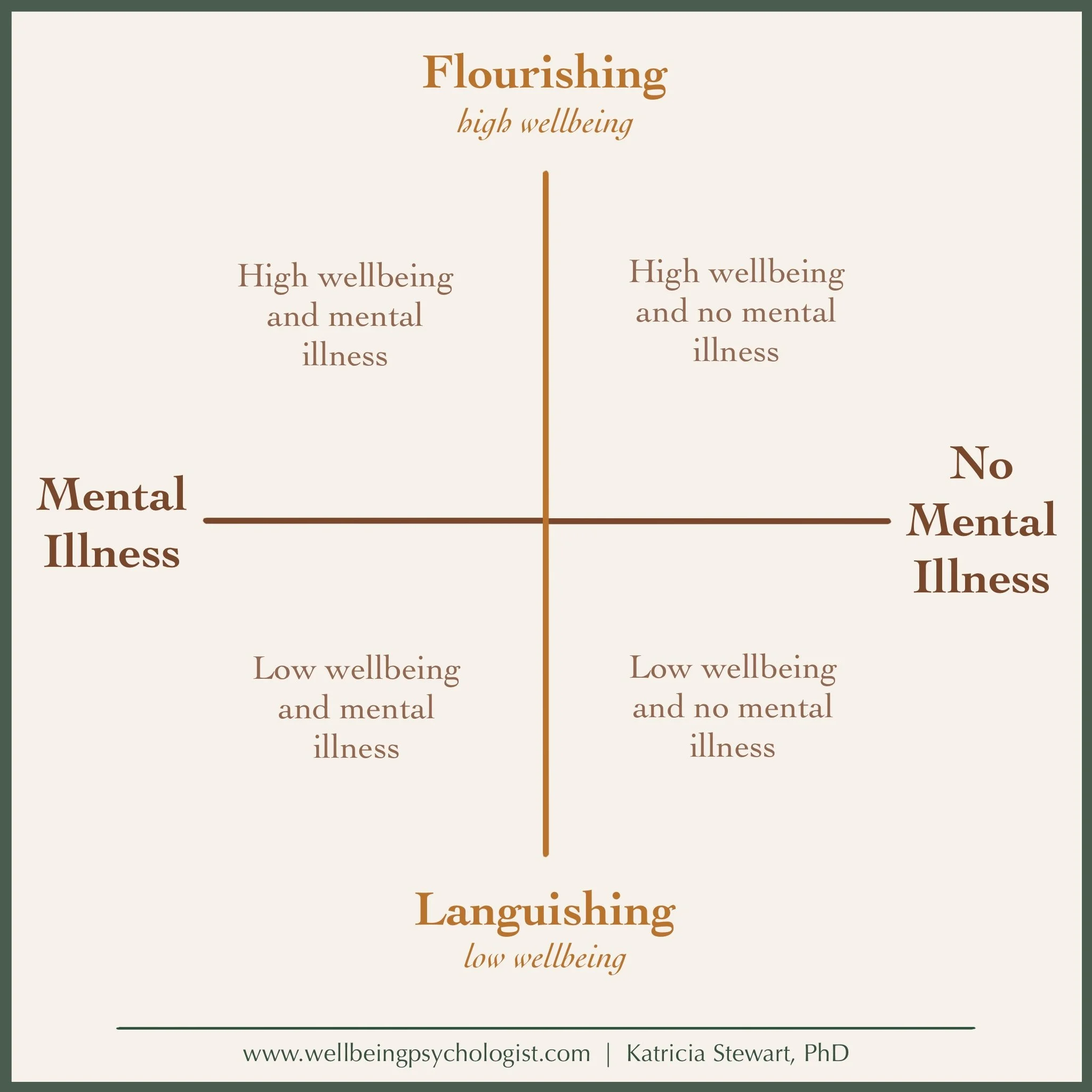
There's a concept in psychology called languishing. It's not depression, exactly. It's more like the absence of flourishing — a kind of gray, muted experience of life where things are fine, technically, but something feels missing. You're not drowning, but you're not swimming either. You're just... there.
Corey Keyes, the sociologist who developed this framework, positioned mental health not as a single spectrum from sick to well, but as two intersecting dimensions: the presence or absence of mental illness, and the presence or absence of well-being. What this means is that you can have no diagnosable mental illness and still be languishing. And you can be managing a mental illness and still be flourishing in meaningful ways. Mental illness and well-being are related, but they are not the same thing, and conflating them has led us to underinvest enormously in our actual well-being. A lot of what we see out there is about supporting our mental health — but our well-being is different than our mental health, though the two have many correlations.
This course is about well-being: moving toward flourishing across the mental-emotional, relational, and spiritual dimensions of your life.
But before we get into the practices, I want to name something that often goes unsaid in well-being spaces.
What We’re All Swimming In
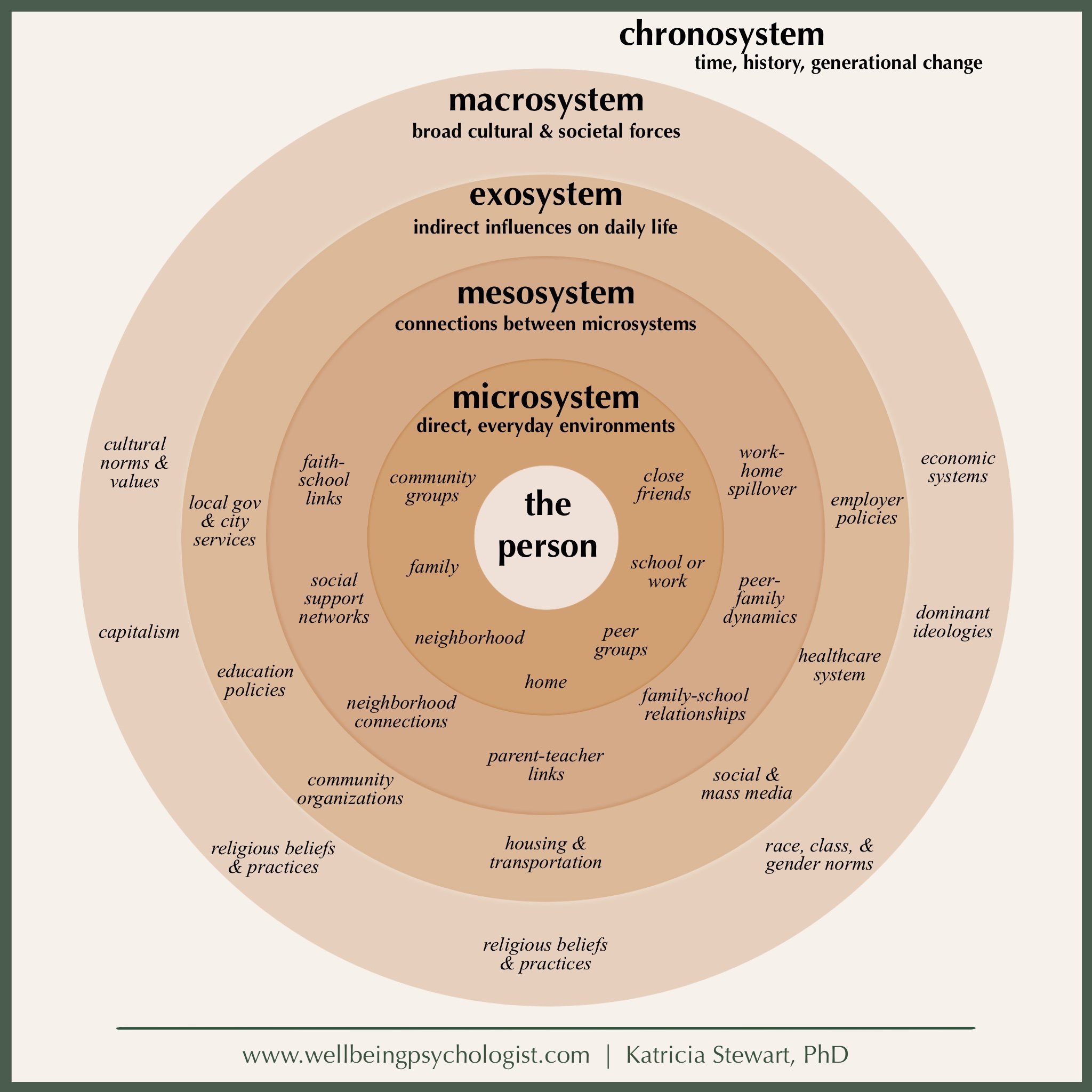
Well-being doesn't happen in a vacuum. It happens inside a body, inside a nervous system, inside a life — and that life exists within economic systems, cultural norms, family histories, community conditions, and social structures that have enormous power over how we feel, what we can access, and what's even possible for us.
This course focuses on what you can do at the individual level. That's intentional, and it's also a limitation.
For some people, the gap between languishing and flourishing won't close through individual practice alone, because the roots of their languishing aren't primarily individual. They're structural. An economic system that treats rest as laziness and productivity as virtue, that requires most people to work more than is sustainable just to meet basic needs — that system creates suffering that mindfulness and gratitude practices can only partially reach.
[See diagram of the ecological model.]
There's a particular strain of self-help culture, heavily influenced by a decontextualized version of Buddhist philosophy, that has quietly absorbed a very Western, very capitalist assumption: that the right mindset can overcome anything. That with enough grit, perspective, and personal optimization, you can flourish regardless of circumstances.
Buddhism is genuinely wise about the mind and about suffering. But much of what gets translated into Western wellness culture strips away the rest of its context — the community, the ethics, the systemic critique — and leaves behind something that sounds a lot like "pull yourself up by your bootstraps" with a meditation cushion underneath it.
I say this not to be cynical about mindfulness practices (some of which are used in this course). I believe in them. I've seen what they do. There is science behind them. But I think it matters to hold them in the right frame: as tools that support well-being, not as evidence that your flourishing or languishing is entirely your own doing.
So what do we actually do?
We work on ourselves. We use the tools available to us. And we also let ourselves off the hook for not optimizing our way to perfect wellness in a world that was not designed with our flourishing in mind.
Part of that work, I'd argue, is actively practicing what I'd call anti-optimization. Staring out the window. Napping without earning it first. Doing things purely because they feel good in the present moment, with no productivity justification required. Reading something that has nothing to do with becoming a better version of yourself. Sitting in a garden. Cooking slowly. These aren't guilty pleasures or wasted time. They are the kinds of experiences human beings evolved to have — and slowly returning to them is one of the ways we begin to rewire a nervous system that the modern world has trained into a near-constant state of urgency.
The goal, eventually, is that the joys of life become their own ends. Not inputs to some productive output. Not content for your growth journey. Just good things that are worth having because they're good.
At some point, something shifted in our culture. The things that brought us pleasure (moving our bodies, being in nature, making food, sitting with people we love) got annexed and repackaged as means to something more "serious." Exercise became optimization. Sleep became a performance metric. Even rest has a hustle version now.
This course won't reverse that cultural moment. But it can help you begin to notice when it's happening in your own life, and it will give you something else to reach for instead.